Knee problems are incredibly common, especially as a person gets older. Many of us can relate to the experience of knee pain, stiffness, or weakness which can limit our ability to do the things we love to do. Once someone starts to have knee problems, they begin searching for solutions by asking friends, doctors, or consulting the almighty internet. However, this all too often leaves people with a hopeless handful of options without any idea of where or how to start. This is because the knee joint is actually quite complicated. How can you hope to understand what is going wrong with your knee without first knowing how the knee joint works when things are going right?
For this reason, I am going to take you on a journey of understanding how your knee joint is supposed to work. With this knowledge, you can begin to successfully navigate all the treatments and advice you have been given and may encounter in the future. So let’s begin!
What is the purpose of the knee joint?
At its core, your knee joint is designed to support your body weight during all of your daily activities. Your knees are your own personal champions fighting against the tireless pull of gravity while you’re doing things like standing, walking, running, jumping, climbing stairs, getting in and our of chair, or playing sports. In order to be successful in the fight, your knees must have the ability to:
- Provide a strong support surface: It makes sense that the first and most basic function of your knees is to provide a sturdy and stable support surface. How could you hope to stay upright without a solid surface to stand on? This requires that the anatomy of the knee joint has stable and intact connecting bone surfaces and ligaments
- Bend and straighten: Not only do your knees need to be able to support your body weight, but they have to be able to do this in a wide range of positions from bent to straight. Think about how hard it would be to stand up from a low chair if you couldn’t bend your knees, or how uncomfortable it would be to stand upright if you couldn’t straighten your knee.
- Absorb impact: Not much of our life has us staying stationary, so your knees also need to be able to absorb impact when performing movements. When I say “absorb impact”, activities like running or jumping may come to mind, but even everyday activities like walking or stepping off a curb create impact through your legs which you knee joint must absorb. Impact that isn’t appropriately absorbed has a high potential to cause pain and damage at your knees, hips, and low back
- Generate force: Lastly, your knees need to be able to generate force, or, put another way, they need to be strong! As you are moving from place to place, you need strength from your muscles to propel you where you want to go. Without appropriate strength at your knees, you won’t be getting very far.
- Play nice with your other joints: The last thing we need from a healthy knee joint is work well in relation to the other joints around need. This means that the ankles below the knee, and the hips and low back above the knee also need to be working as a team with the knee joint to facilitate all the things we talked about above.
Anatomy of the knee joint:
Now that we know what the key jobs of the knee joint are, lets take a look at the anatomy to understand how the knee is able to do these jobs so well when it is healthy:
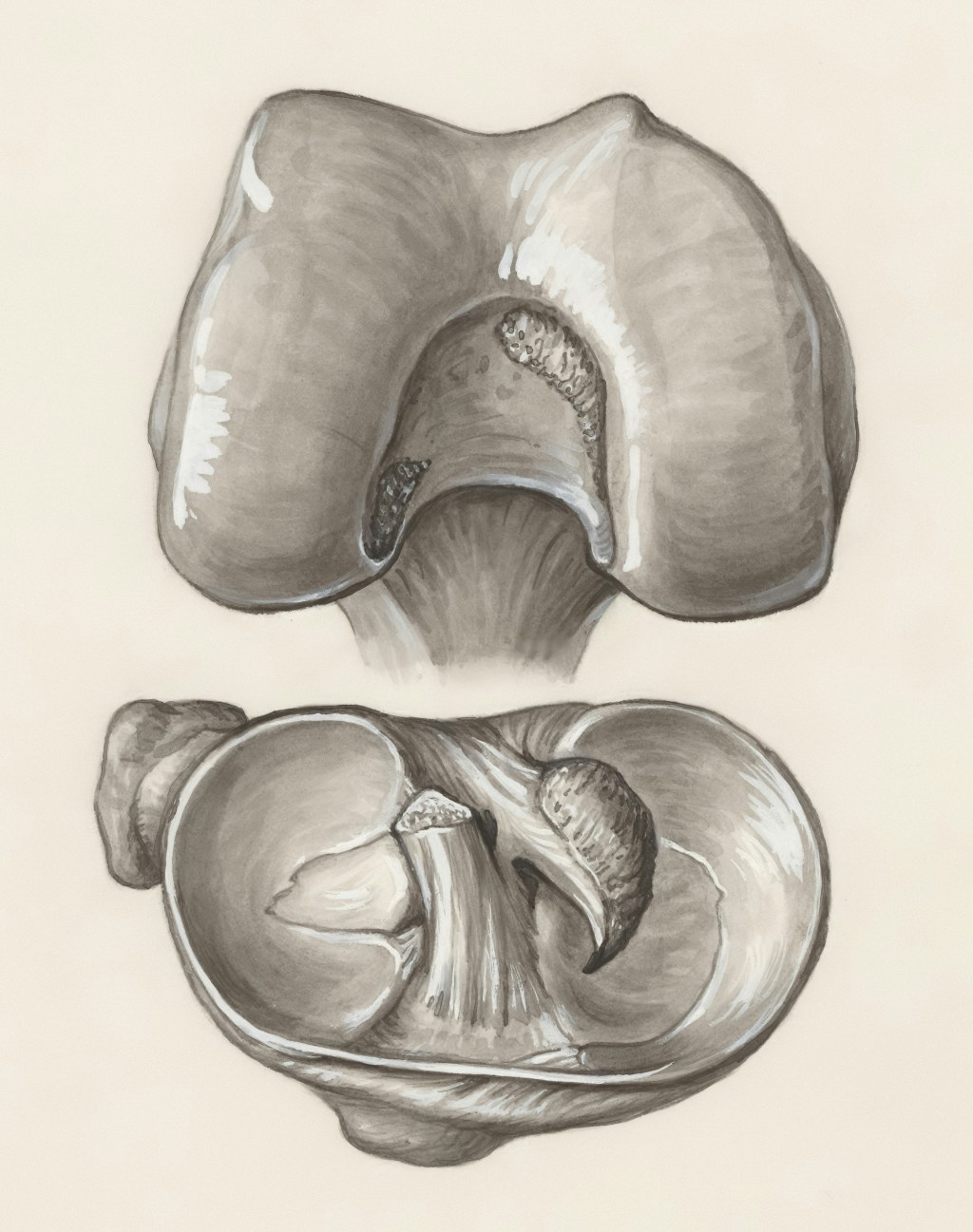
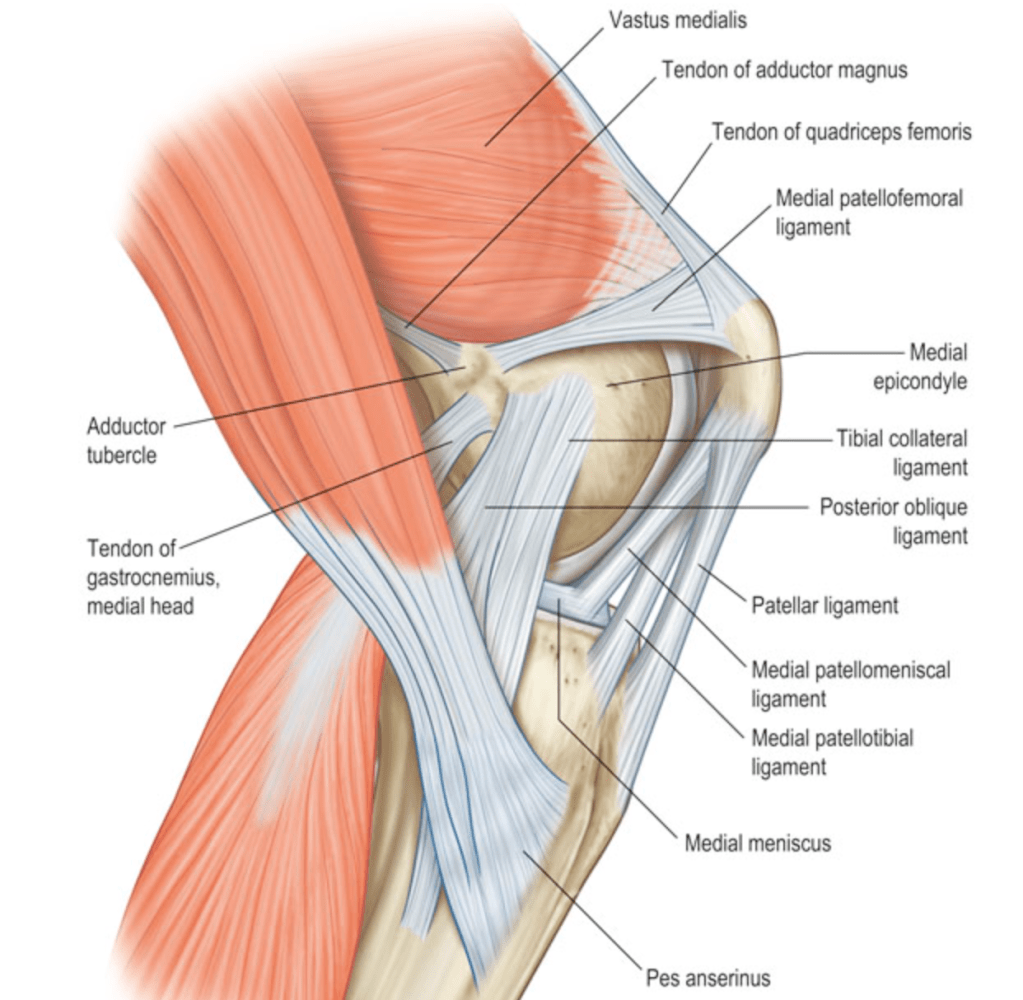
Bone structure: The primary bone support for the knee joint comes from the contact between the thigh bone (or femur) and the shin bone (the tibia). These two bones make the primary weightbearing surface of your knee, so contact between these two bones provides the support for the entirety of your body weight. There is also another connection between your knee cap (or patella) and your thigh bone. The knee cap doesn’t support your body weight directly, but it will take on a lot of load, especially if your knee is bent.
Articular cartilage: The contact points between these bones are supporting, literally, hundreds to thousands of pounds of weight at any point where you are standing on the ground. That’s a lot of weight… So how does your knee handle all this? Well this is where cartilage comes into play. You articular cartilage (a special type of cartilage that covers the ends of your bones) is a really tough structure with two purposes: the first is to act as a shock absorber between your bones, and the second is help your bones glide across each other easily. An amazing fact (that I personally find really cool) is that healthy cartilage sliding on top of healthy cartilage is creates less friction than two pieces of ice on top of one another.
Meniscus: In addition to your articular cartilage, we have another specialized type of cartilage in the knee joint called the meniscus. Many of you have probably heard of this one as well. The menisci are like two big bumper cushions on each side of your knee joint, the inside and the outside, which are incredibly effective and absorbing shock in the joint, and they also take up space which allow your thigh bone and you shin bone to hug tightly on to one another.
Ligaments: So we have these three bones, your thigh bone, your shin bone, and your knee cap, and we have this great system, made up of your cartilage and your menisci, to absorb load and eliminate friction. But how does this all stay together? Well your knee joint has 4 big ligaments, which are like thick ropes, which tie these bones together, I’m if many of you watch or have played sports, you’ve heard of athletes having an “ACL tear” or an “MCL tear”, well these are some of the ligaments I’m talking about here. Beyond just tying the joint together, these ligaments also have tiny little nerve sensors in them, which help our brain understand exactly where all of these bones are in space they’re moving. This is critical information which allows you to prevent movements or positions which are damaging to the knee joint.
Joint capsule and fluid: With all these amazing joint structures, your body wants to package them up nicely for you. Everything we have talked about gets wrapped up in something called the “Joint capsule”. This is just a wrapping of fibrous tissue around the whole knee joint to create a contained joint space. One critical job of this joint capsule is to hold in fluid. This fluid contained within your knee joint is super important because it delivers oxygen and nutrients to your cartilage and ligaments.
Muscles: So far, I have described this amazing, stable structure which can handle thousands of pounds of loads across a big range of motion, but what are we missing? Well of course, we want to actually move this joint! The knee won’t do us much good if we can’t actually create movement through it. This where muscles into play. We have three big muscle groups that allow us to effectively move this joint: the quadriceps (which is the muscle group on the front of your thighs), the hamstrings (which is the muscle group on the back of your thighs), and the calf muscle (which is, of course, the muscle group here on the back of your calf). These muscles are absolutely critical to keeping your knees healthy and allowing you to do the things you love. With a show of hands: how many of you like playing golf, or pickle ball, tennis? Okay, how many of you have younger kids or grandkids? Do you like being able to pick them up or play with them? Now if I haven’t gotten you to raise your hands yet, I’m about to: How many of you would like to be able to stand up out of your chairs when you leave here? Come one, that’s gotta be every one of you! Well all of these muscles have to be appropriately strong in order for you to do these things.
Connection with other joints: The last component to healthy knee function is the joints above and below it. You see, all the joints in your lower body are connected, and your knees can sometimes be the victim of problems at your ankles, hips, and lower back. You can see how your knees are precariously sandwiched between all these other joints, so if they aren’t doing their jobs right, you knees could suffer the consequences.
How can it all go wrong?
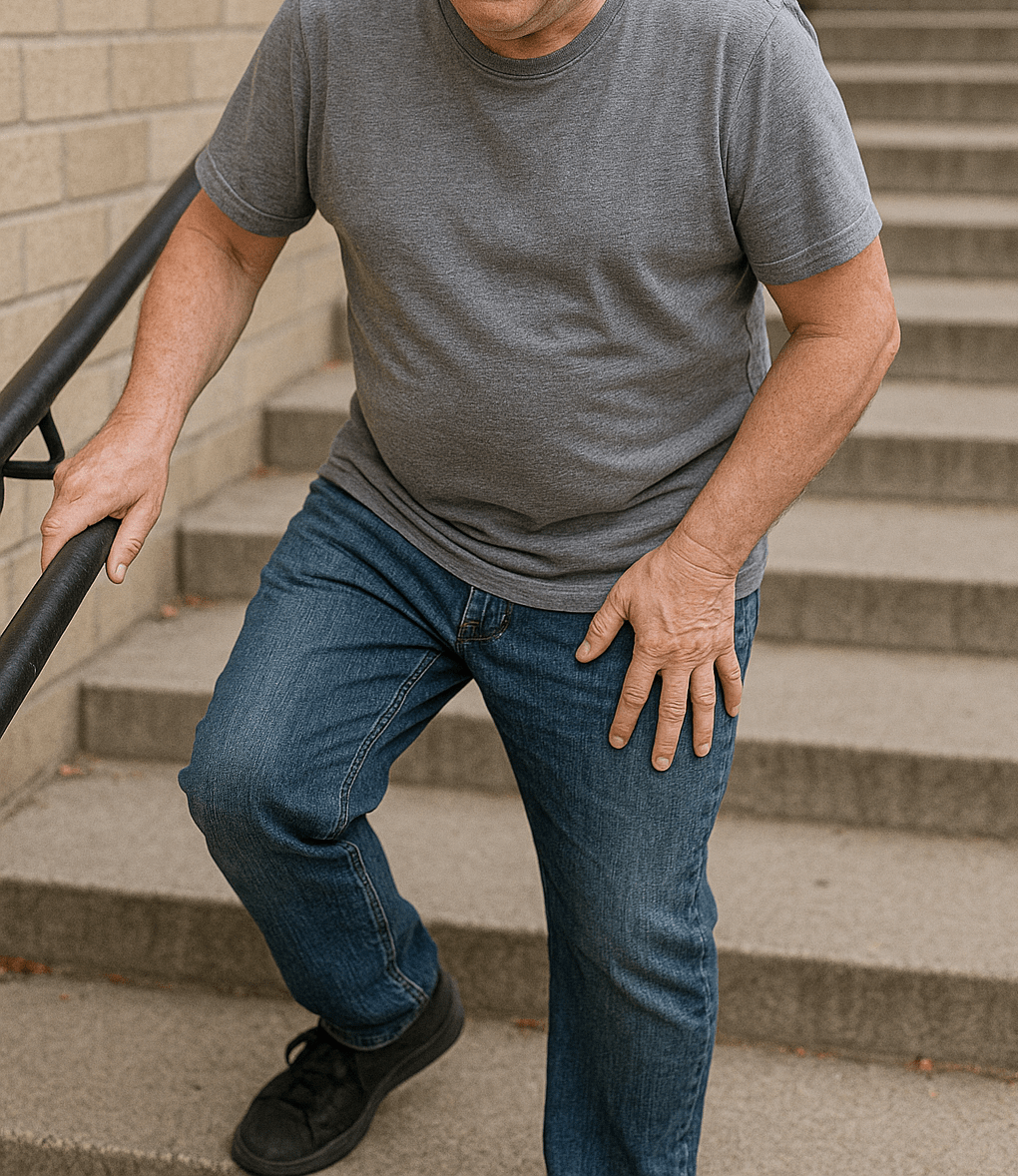
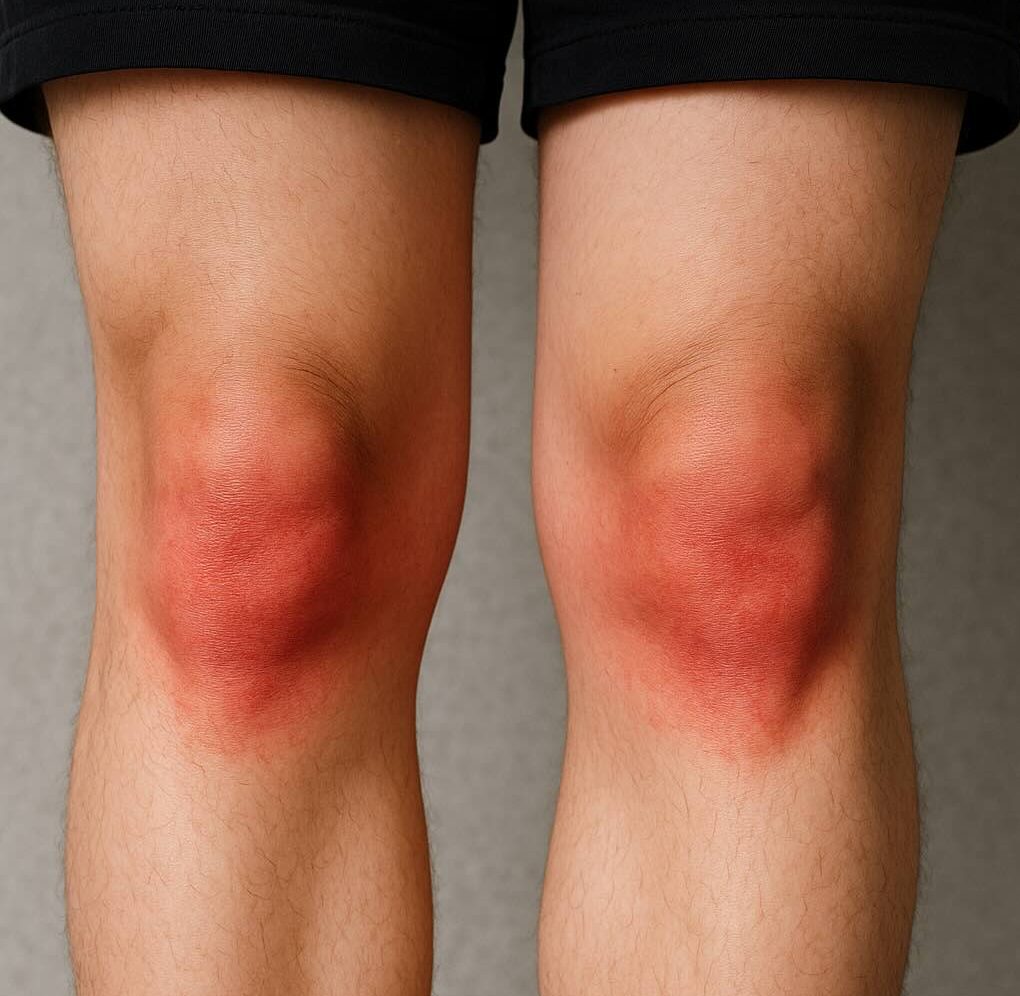
We’ve come a long way in this article, and I hope you now have a good understanding of what the knee joint is and how it is supposed to function. But what happens when we start to have problems with knee joint? To put it very simply, any time one of these tissues or structures that I have described starts to malfunction, we can start to have knee problems. To put it another way, if you are experiencing knee problems, you can likely attribute it to one, or often times a few, of these structures. If you’re interested in the different pathologies of the knee joint and what you can do about them, check out some of my other articles!



 What you Kneed to Know
Leave a reply to Why are My Knees Breaking Down? Part 1: Mechanical Loading – What you Kneed to Know Cancel reply