Welcome to Part 3 in my series diving deep into why knees breakdown over a lifetime. If you haven’t already, check out Part 1: Joint Loading and Part 2: Inflammation. In this article, I’ll be talking all about the muscles of the lower extremity, their key functions, and how the success or failure of these functions can impact the health of your knees in the long term.
Muscles of the knee
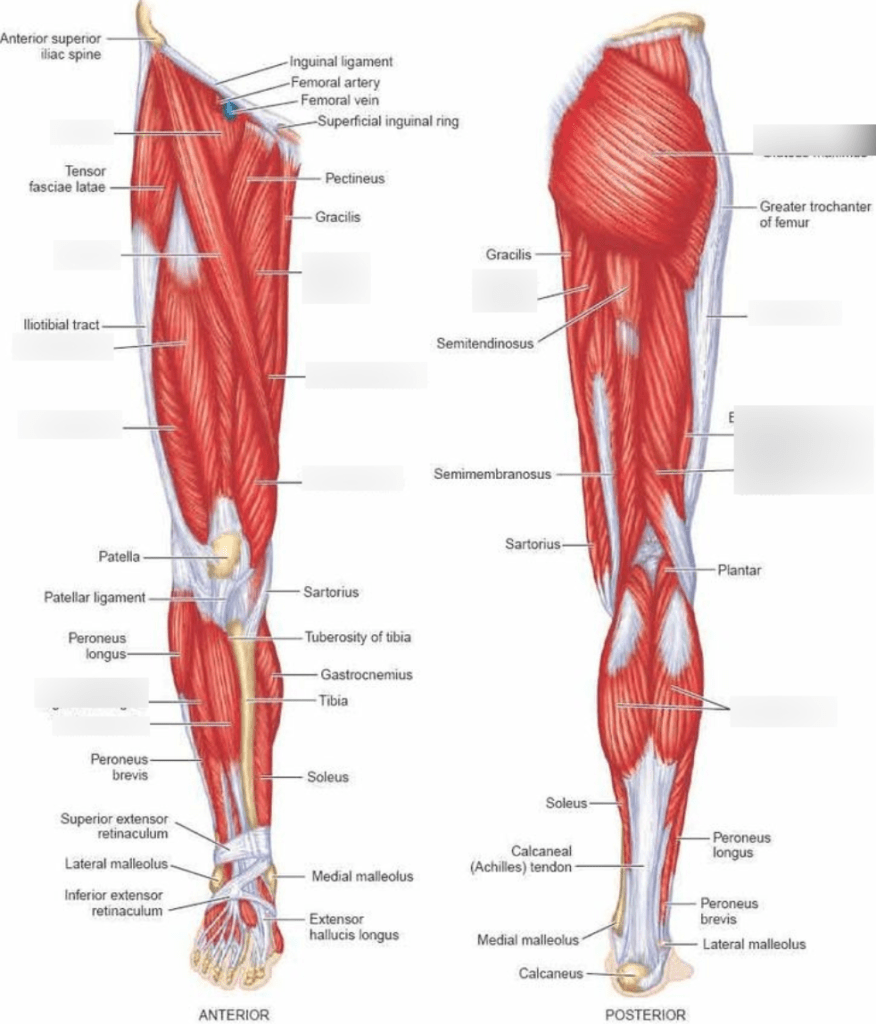
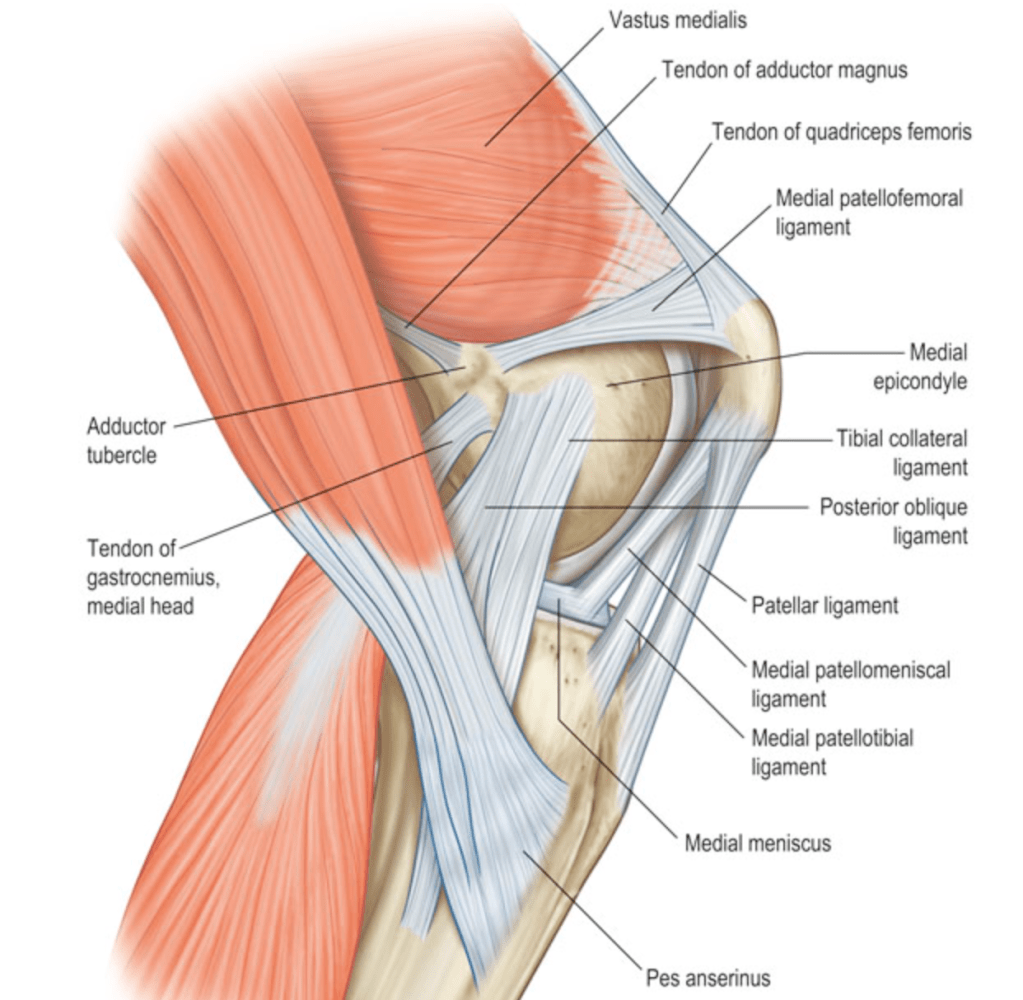
The musculature of the knee is very complex (see picture above), but their are 3 main muscle groups that contribute directly to the primary movements of the knee:
- Knee extensors: This is the muscle group which extends, or straightens, the knee joint. The primary group of knee extensors is the quadriceps. The quadriceps are the big group of muscles that sits on top of your thigh. If you sit down and kick your knee out straight, you will likely see or feel this bulk of muscle activate. The knee extensors play a crucial role in getting up and down from a squat position (think standing up from chair) and absorbing load through the knee as you walk, run, or jump.
- Knee flexors: This is is the muscle group which flexes, or bends, the knee joint. The primary group of knee flexors is the hamstrings. The hamstrings make up the bulk of the muscle on the back of your thigh. If you stand up and bend your knee back behind you, you will feel the hamstrings activating. Similarly, you can feel the tension or stretch on your hamstrings if you bend over to touch your toes. The hamstrings play a critical role stabilizing and protecting the knee joint during movements such as walking, running, and jumping, and they also serve to extend, or straighten, the hip while getting up from a squat or standing up from a bent over position.
- Calf muscles: The calf muscles, or gastrocnemius, are the last primary muscle group which crosses over the knee joint. You can feel and see this muscle group working if you stand up on the balls of your feet and raise your heels off the ground. While we often think of this muscle group as moving the ankle (as we experienced in the heel raise example), it is important to note that these muscles also cross over the back of the knee to inter-lace with the hamstring muscles. For this reason, the calf muscles can play a key role in bending and stabilizing the knee joint. Also, strong calf muscles can help absorb and dissipate loads during high impact activities, such as running or jumping, before these loads can act on the knee joint.
Do only knee muscles matter?
The muscles that cross the knee joint and directly contribute to knee movement get the most attention when we talk about knee health, but other muscles in the body can also play a key role in maintaining knee health. The knee joint is situated between the joints above it (the hip and trunk) and the joints below it (the ankle and foot), so the movement and function of the knee is highly dependent on the muscle function of these adjacent joints.
- Trunk: You may also know the trunk as your abdomen or your core. The muscles which control your trunk movements are primarily your abdominal wall and low-back extensor muscles. Proper muscle function of the trunk determines the position of your center of mass and the movement of your pelvis. If these components are not moving properly, it can place undue stress on all the joints below (including the knee).
- Hip: The hip is the joint directly above the knee, and many of the muscles which move the knee joint (like the quadriceps and hamstrings) also have a direct function to move the hip; therefore, the movement of the hip and knee are directly related. A very important group of muscles that we have not talked about yet is the hip extensors and external rotators (also referred to as the Gluteals or Glutes). These muscles at the hip play a key role in preventing the inward collapse of the knee joint during dynamic movements such as walking, squatting, running, and jumping. Further, well functioning Glute muscles can offset load from the knee joint to the hip so that the knee is protected from excessively high forces.
- Foot and ankle: The foot and ankle are directly below the knee joint. Similar to the hip, the muscles at the ankle and foot have a direct impact on the stability of the knee. Strength and stability at the foot and the ankle can reduce impacts and improve loading patterns through the knee during all weight-bearing activities.
Muscle functions and how they can impact knee health
We know that the muscles of the knee and the surrounding joints need to be functioning properly for optimal knee health, but what is the “proper” or “ideal” function of muscles? What are the things that we actually need our muscles to do? Well, there are a few basic functions of muscles which allow your knee (and other joints) to move well and stay healthy:
Create Movement: The most obvious function of muscles is their ability to create movement. Whenever we want to move our bodies, our muscles must contract to create the desired movement. For example, when we want to stand up from a chair, our knee and hip extensors must contract to lift our body weight up. When we want to walk upstairs, we must have sufficient muscle function to lift our leg high enough to clear each step and lift our body weight to the next step. Without sufficient capacity of our muscles to create movement, we quite simply can’t participate in life the way that many of us want to. The knee joint is really only as functional as our ability to move it; if there is not sufficient muscle quality to create movement at the knee during daily activities, then the knee as a whole really isn’t that useful to us.
Slow Down Movement: On the other side of creating movement is slowing down movement. You may be thinking, “Why would I want my muscles to make me move slower?”, but our muscles’ ability to slow down movement is how they absorb and control forces acting on our bodies, and I’m sure you can think of many instances where this would come in handy. When you are walking down a steep hill, gravity is trying to pull you down the hill faster and faster, and it is up to your quadriceps to slow down and control your decent. Similarly, when you land from a jump or even step off a high curb, you need to be able to rely on your calf muscles, knee extensors, and hip extensors to absorb the impact of hitting the ground. Without a sufficient capacity of your muscles to slow down movement, loads and forces are transferred to the less resilient tissues, such as ligaments and cartilage, of your knee joint. Over time, this undue loading of the passive structures in your knee can cause them to breakdown.
Coordinate Movement: Beyond acting as the accelerator (creating movement) and brakes (slowing down movement) of the body, your muscles also act to coordinate movement. A well coordinated movement is one that gets you from point A to point B using the least amount of energy possible without creating tissue damage or pain. This means that all the muscles around your knee and adjacent joints must work together to contract at the exact right time and with the exact right amount of force. When our muscle coordination is impaired and we begin to adopt sub-optimal movement patterns at the knee, trunk, hip, or foot, we again place undue stress through the cartilage, bone, and ligaments of our knees, which can contribute to long-term breakdown.
Prevent Traumatic Injuries: We’ve talked about how muscles can create, slow down, and coordinate movements to prevent chronic degeneration, but these functions are also very important to prevent acute, traumatic injuries to the knee. A traumatic knee injury would be a strain, tear, or break of any of the structures of the knee. If the muscles of our lower extremity are not strong enough to handle the loads placed through the joint or coordinated enough to create a movement in the right way, then the cartilage, ligaments, tendons, bones, and muscles of our knee are at a greater risk for traumatic injury. Traumatic knee injuries cause a massive and prolonged inflammatory response while simultaneously destabilizing the knee making it prone to problematic loading patterns; for this reason, people who have suffered traumatic knee injuries have a much greater risk for knee degeneration later in life.
Metabolic Regulation: A very often overlooked function of muscle tissue is its ability to act as an endocrine organ. This means that muscles will release chemicals in response to activity that can affect the health of body tissues both locally (like the quadriceps affecting the knee cartilage) and systemically (like the quadriceps having an effect on whole body health). The chemicals released by muscles are referred to as “myokines”. These myokines have the ability to reduce inflammation and regulate cell metabolism to improve long-term cellular health. This means that having a larger amount of muscle mass surrounding the knee joint can have a direct effect on the cartilage, ligaments, and bones of the knee to reduce inflammation and preserve long-term health. Additionally, muscles are critical for regulating whole body metabolism as greater muscle mass is linked to reduced risk of obesity, diabetes, and other metabolic diseases that are known to promote knee joint degeneration.
Poor muscle function and degeneration over time
These past few sections have reviewed how the whole lower extremity musculature interacts to impact the knee joint, and how the various functions of muscles could impact the long term health of the knee, but what do we see when we actually investigate the relationship between muscle function and knee degeneration in scientific studies? As you can imagine, we see quite a strong relationship.
Studies looking into the muscle strength of individuals with knee osteoarthritis (i.e., knee degeneration) consistently find that those with knee osteoarthritis have significantly decreased muscle function. More specifically, individuals with a diagnosis of knee osteoarthritis show decreased strength, power, coordination, and size of the muscles around their knees and hips when compared to healthy individuals. Interestingly, while this decrease in muscle function was worse in the leg with knee degeneration, it was present in both limbs. This identifies a link between knee degeneration and general muscle strength in the body, not just the strength of the affected leg.
This evidence leaves us with a “chicken-or-the-egg” scenario: is it that decreased muscle function causes knee degeneration, or is it that knee degeneration causes loss of muscle function? The answer seems to be both. Those with more severe knee degeneration show worse function of their knee muscles compared to those with less severe knee degeneration, indicating that greater degeneration leads to impaired muscle function. Adding to this, scientists have followed individuals who are at risk of developing knee osteoarthritis, and they found that those who had worse muscle function at baseline were more likely to develop knee degeneration and overall functional decline in the future. Further, among individuals with a diagnosis of knee osteoarthritis, impaired muscle function was shown to be a significant risk factor for more rapid progression of knee joint damage, more rapid loss of physical function and quality of life, and a greater likelihood of needing a total knee replacement over the following few years.
All of this evidence again highlights the downward spiral that we all-too-often see among those with knee degeneration. Loss of muscle function promotes knee degeneration, greater joint degeneration promotes loss of muscle function, and this more quickly accelerates joint degeneration. Thus, it is critical that we address muscle function deficits as early as possible to maximize our chances of preserving knee health over a lifetime.
How do we maintain muscle function to preserve joint health?
Thankfully, we see that interventions to address muscle function deficits are very effective for preventing knee degeneration before it happens and for mitigating knee degeneration which has already started. Those that engage in regular training and exercise to preserve muscle health show less structural knee damage, better physical function, less pain, greater quality of life, and decreased risk of invasive surgeries like total knee replacement. I will have an entire article dedicated to exercise interventions for managing knee degeneration, but, for now, here are the key elements of muscle function which need to be addressed to preserve long term knee health:
- Strength: the ability of a muscle to produce force
- Power: the ability of a muscle to produce force quickly
- Endurance: the ability of a muscle to produce force repeatedly over multiple contractions
- Coordination: the ability of a muscle, or a group of muscles, to produce the right amount of force at the right time
- Mobility: the ability of a muscle to produce force throughout a large range of motion
With these factors in mind, you can work on your own, with a personal trainer, or with a physical therapist to develop an exercise protocol and begin your journey towards lifelong knee health!

 What you Kneed to Know
Leave a comment